Showing posts with label Amputation. Show all posts

Tuesday, March 24, 2015

Florida Artifacts Road Trip!


In February, the National Museum of Civil War Medicine was contacted by a cardiologist in Ocala, Florida, looking to donate a large collection of Civil War medical items.  Since the collection was a rather large one, measures had to be taken here in Frederick to ensure that we had the space to accept the artifacts.  The work room for the curator was crowded with risers and cases and needed to be cleaned out.  Shelving would also have to be brought in to store everything on.


With this work completed, Tom and Jake headed down to Florida to pick up the artifacts.  Arriving on Sunday, they worked with the doctor to pack three rooms worth of medical artifacts.  Not only were there items from the Civil War, but there were many post war items, and a large amount of pre-war items.  There were commissions, photos, tools, and many different medical cases.


Tom and Jake worked for six hours loading the collection, after which they left for the long drive north.  They drove through the night, stopping only for food and gas, and to switch driving duties.  Two hours on, two hours off.  They made great time.  They arrived back in Frederick at 4:30 am.  After dropping Jake off, Tom came to the museum at 5 am and unloaded all of the artifacts off of the truck and into the lobby.  Finally exhausted, he slept for an hour in the office, after which he moved all of the boxes into the quarantine room.


The next day, all of the boxes were unpacked; the artifacts were placed on the shelves in their temporary home.  This is where the collection will “live” for the next few months, while they are cleaned, preserved, and cataloged in hopes that soon they will be placed on display.


Items cannot simply be placed right back into the collections room. The first step is to place them into quarantine.  The reason for this is to ensure that items have not been exposed to materials that may cause damage to the artifacts in the collections room.  The most common concerns may include bugs and mold.  While the artifacts are in quarantine, they are checked for anything that could damage not only themselves but other artifacts.


 So, stay tuned, and hopefully soon you can see some of these items on display!


Thomas Frezza
 Photos courtesy of the National Museum of Civil War Medicine, except where otherwise noted.

Thursday, October 9, 2014

An Amputation Table

     Since the 150th anniversary of the Battle of Cedar Creek is in just a few days, I thought this week I should feature an artifact from that battle.  It may not be what you expect though!
     Normally when you hear a surgical procedure mentioned, there’s an associated image of a surgical table and an operating room.  However, surgeons on the battlefields during the Civil War didn’t have these luxuries.  They had to improvise with the supplies they could find in the immediate area.  Fashioning a surgical table could involve putting a door on top of two barrels or chairs, or commandeering a table from someone’s home.  That is exactly what happened to an otherwise very ordinary kitchen table in the NMCWM’s collection!
Usually when visitors see our amputation scene they notice the patient, the medical personnel, and the surgical instruments.  It’s easy to overlook the actual artifact in this scene - the table.
     It is a fairly basic pine kitchen table.  The top is composed of five wide planks.  Underneath, there is one drawer with two small ivory handles.  In the photo above, you can see some dark stains on the top near one end – possibly blood stains?  We haven’t had any testing done on the table, so we can’t say for certain. 
The table and its former home, the Daniel Stickley House, were even featured on a postcard in the 1920s.  According to the caption on the postcard, “This substantial house, built in 1859, is on the Shenandoah Valley Pike midway between Strasburg and Middletown, Va.  During the Battle of Cedar Creek, fought October 19, 1864, between Federal forces under Sheridan and the Confederates under Early, a cannon ball passed thru the gable of the building.  The house was converted into a field hospital, and scores of operations were performed upon the table, shown in insert above.  So great was the call for surgical aid that the amputated arms and legs were piled higher than the table before they could be buried.”
     The table was kept in the Stickley family for many years, and by their accounts was still used in their kitchen until sometime in the 1940s.  One person did note though, that she remembered the top being covered in linoleum in later years.  I would imagine that if you knew there had been amputations performed on your kitchen table, you might want to cover the surface!  There is another story about a Civil War veteran who had been one of the patients on the table, who returned to the house and carved a small sliver of wood from it as a souvenir.  
There does appear to be a piece of wood missing from the frame!
     That’s quite a story for a little wooden table!
Photos courtesy of the National Museum of Civil War Medicine.

Originally published by Lori Eggleston
Guardian of the Artifacts

Thursday, May 22, 2014

The History of a Surgical Kit

     Since I work at the National Museum of Civil War Medicine, I’m sure you’d naturally expect that the artifacts in the museum’s collection relate to Civil War medicine.  That is generally true, but there are a few items which may not appear to relate at first glance.  Today let’s take a look at a surgical kit which fits this category.
This kit is a four-tiered general operating set, ca. 1875, manufactured by J. H. Gemrig of Philadelphia.  Though the kit and surgical instruments are similar to those used during the Civil War, the date places it as a post-war kit.  So why would it be included in our collection?

     The kit belonged to Gerard F. Mason, M.D., of Charles Town, Virginia (later to become West Virginia).  By all accounts, he was a respected and prosperous physician in the town.  His oldest son, William L. Mason, was a member of Baylor’s Company, 12th Cavalry, C.S.A.  However, Gerard Mason did not serve in the military.  His story is linked to someone whose name might be familiar to you though.  
Portrait of John Brown in 1859.  On October 16, 1859, John Brown led a raid on the United States Armory and Arsenal at Harper’s Ferry, Virginia.  His goal was to abolish slavery through armed insurrections.  He was captured though, then put on trial, convicted, and sentenced to death.  Image from Wikipedia.org.
  
     During his trial, the wounded Brown declared that he was too ill to attend court.  His claim was suspected by some to be a ruse to delay his trial.  Millard K. Bushong wrote in A History of Jefferson County, West Virginia, that “Brown was examined by Dr. Gerard F. Mason, a reputable Charles Town physician, who pronounced him perfectly able to stand trial.”  The trial was not postponed, but Brown requested to be carried from jail into court on a cot and to give his testimony while lying on a couch.  However, it is interesting to note that when court was adjourned that day, he walked back to his jail cell!  
     So, Dr. Mason’s distinction comes from being the physician who examined John Brown and declared him fit to stand trial.  Records also show that Dr. Mason was one of the physicians who examined John Brown’s body after his execution.  His surgical kit, though manufactured after the Civil War, still has a connection to Civil War medicine, as well as a story to be told.   
You can see that the kit has the name “Holliday” engraved on the lid.  It originally belonged to a Dr. Samuel Holliday in Winchester, Virginia who died without children.  His sister, Margaret, ended up with kit.  She also ended up becoming Mrs. Gerard Mason, which is how he came to own this kit!  It continued to be handed down to family members until it was donated to the NMCWM by a descendant of Dr. Mason’s.

     And that’s one of the best parts of my job - you never know what sorts of stories you will discover!
Photos courtesy of the National Museum of Civil War Medicine, except where otherwise noted.

Thursday, May 8, 2014

What's in the box?

  Last week I posted about my trip to North Carolina to pick up an artifact for my museum.  This week I’ll finally tell you about the artifact! 
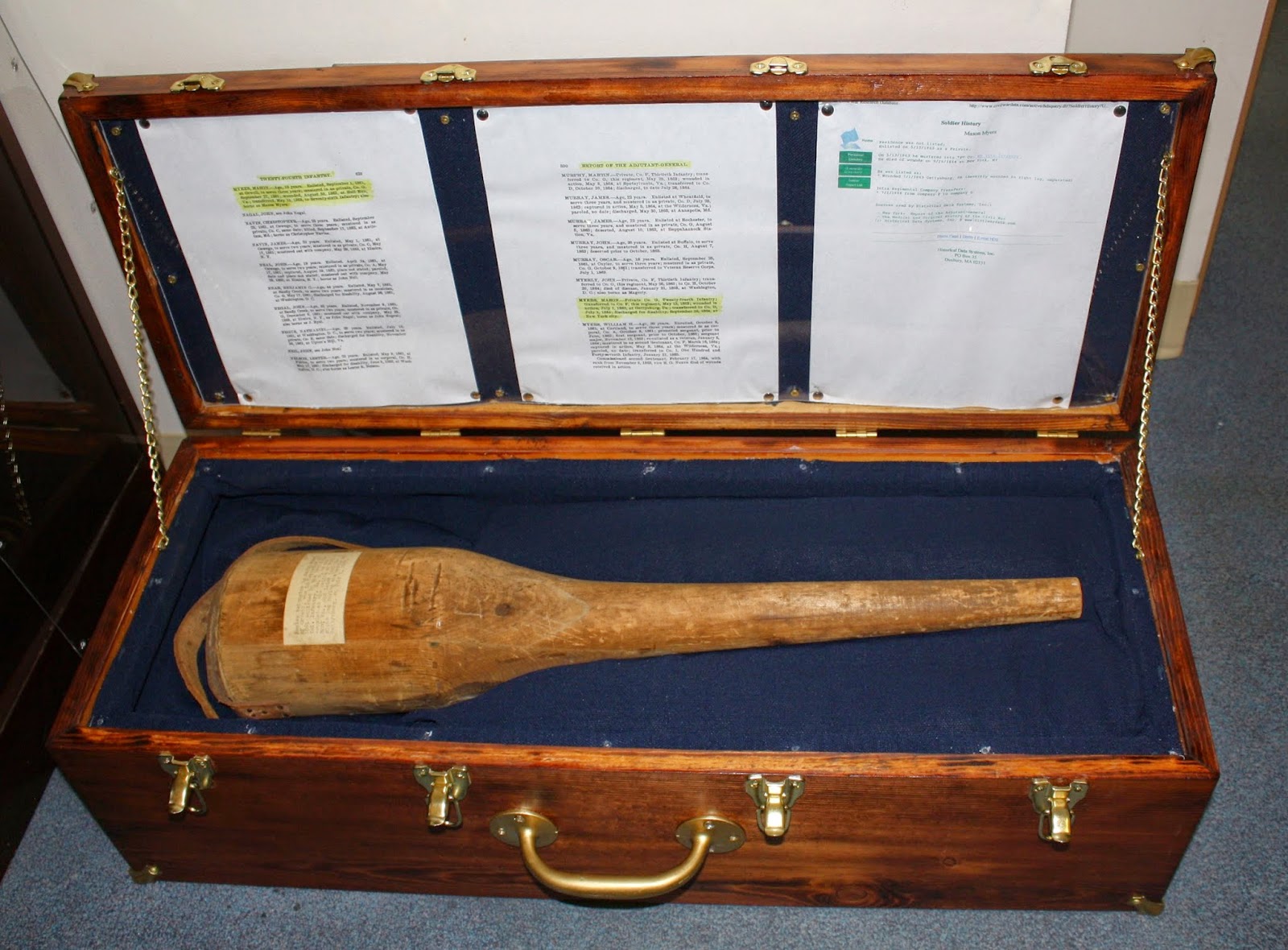
No, this isn’t the artifact!  It was made by the artifact’s owner to protect and store it.  You can probably guess that it belonged to a Civil War soldier named Mason Myers.  Do you have any ideas about what could be in this box?  Maybe a little more information will help…. 
     Private Mason Myers was a Union soldier from Orwell, New York.  He enlisted in September of 1861 at the age of 19 years.  His enlistment papers list him as being a farmer.  He was 5’8” tall, with a light complexion, dark eyes, and light hair.  He served with the 24th New York Infantry, and later with the 76th New York Infantry.  He was wounded in action during the Battle of Bull Run in 1862 and also during the Battle of Gettysburg in 1863.  He was discharged for disability in September 1864.
This undated photo shows a uniformed Mason Myers (right) with his brother-in-law Robert Armstrong.  I can say for certain that this image was taken before he was  wounded at the Battle of Gettysburg though.    Image from the “76th NY Roster” at http://www.bpmlegal.com/76NY/roster-m.html
     By now, you probably have a good idea about what is contained in the box.  Private Myers was shot in the right leg on the first day of the Battle of Gettysburg, and his leg subsequently had to be amputated.  Afterwards, he needed a prosthetic leg.  
This is the wooden peg leg which is said to have belonged to Mason Myers.
     The U.S. government did have a program which supplied the Union veterans with prosthetic legs.  Mason Myers received an articulated prosthetic leg, which would have looked more like a real leg, through this program in 1864.  He may have used this peg leg before he was fitted for his government leg, or he could have simply preferred using a peg leg.  There were some Civil War veterans who were not satisfied with the articulated legs and chose to use peg legs instead.
A slightly closer view of the peg leg shows the leather straps which held it in place.  These could have attached to a shoulder strap or belt to keep it in place.  You can also see a bit of the edge of the cloth padding for the interior at the very top of the leg. 
  
     There’s an interesting story about how Mason Myers coped with one aspect of being an amputee:
This image shows Mason Myers (left) and his brother-in-law (right) in 1910.  You can see that they are both wearing peg legs.  This isn’t the same peg leg though.  The caption with the photo reads, “Syracuse New York, June 21, 1910 – Three comrades from Orwell, Oswego County, here in the G.A.R. encampment are M.S. Myers, A.J. Potter, and Robert Armstrong, life-long friends and members of Post No. 387.  Comrades Myers and Armstrong are brothers-in-law and both were wounded in the battle of Gettysburg.  The former lost his right leg and the latter his left leg.  They are neighbors and wear shoes of the same size.  Now, when their footwear gives out, they buy one pair of shoes between them and Mr. Myers wears the right and Mr. Armstrong the left.”    Photo taken from the 1962 edition of the Oswego County Historical Society Journal.
     This peg leg is on loan to the National Museum of Civil War Medicine from Gene and Carol Carmney of Marion, North Carolina.  We are grateful to them for the opportunity to study and display it.  We are working on an arrangement to eventually purchase this peg leg, so that it will become a part of the NMCWM’s permanent collection.  Watch for it to be put out on display in the very near future! 
Thank you Gene & Carol – you’ve helped to share the story of Mason Myers and his peg leg!
         
Photos courtesy of the National Museum of Civil War Medicine, except where otherwise noted.