Showing posts with label Antietam. Show all posts

Monday, February 23, 2015

Returning Loaned Artifacts


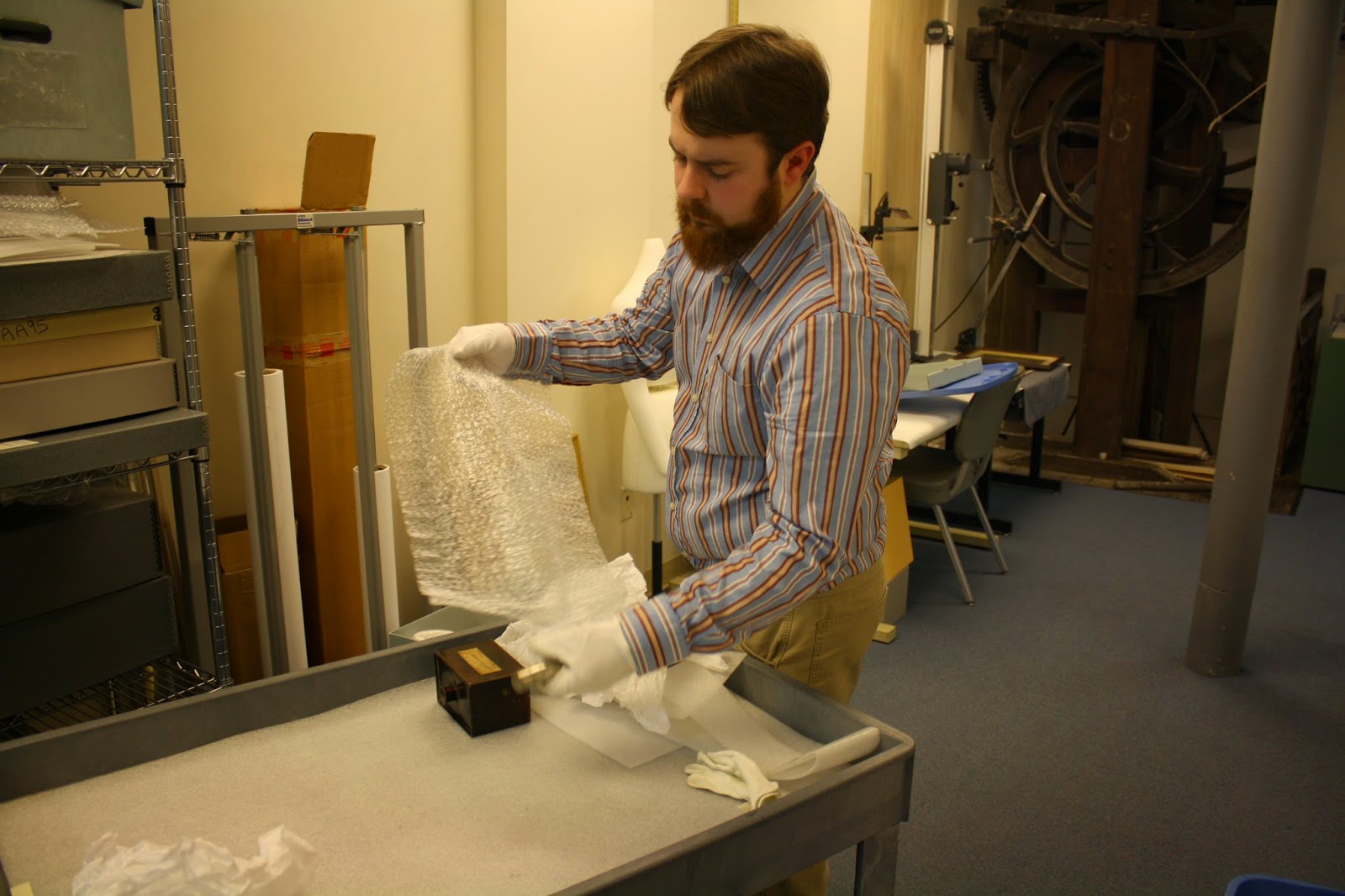
As most people may or may not know, the National Museum of Civil War Medicine has a vast collection of Civil War Medical artifacts that extend beyond those currently on display.  Some items we display have been loaned to the museum and additionally, we also loan items out to other museums and historic sites.  It is a great way to build partnerships, to help fellow museums, and to showcase our name and artifacts.

Kyle, helping to put away some of the returned artifacts.

When the exhibits have run their course the items are then returned and then they start the process of coming back to the museum’s collection.

 And they move down these hallways where we store all of our old exhibit panels.

Items cannot simply be placed right back into the collections room. The first step is to place them into quarantine.  The reason for this is to ensure that items have not been exposed to materials that may cause damage to the artifacts in the collections room.  The most common concerns may include bugs and mold.  While the artifacts are in quarantine, they are checked for anything that could damage not only themselves but other artifacts.

The cart on the right has boxes filled with returned artifacts.

Once the artifact's time in quarantine is up, they can return to the collections room, into the storage drawers where they are housed.  This procedure was followed last week with items that were out on loan, and with the items that came back from our location at the Pry House Field Hospital Museum, which closes down for the winter months.  This procedure is not limited to those items that leave the building, but also with artifacts that come out of the collections within the exhibits here at the National Museum of Civil War Medicine.

The Fitzpatrick items were some of the artifacts on display at the Pry House.

What is great about this process is not the paperwork, but that you can see in one room how awesome the collection is in its entirety.  There is everything from splints to books, from amputation kits to a Civil War Condom.  It is very fascinating to see these artifacts that are well cared for by the staff at The National Museum of Civil War Medicine.

The sword returned from the Fitzpatrick exhibit.

Thomas Frezza
 Photos courtesy of the National Museum of Civil War Medicine, except where otherwise noted.

Wednesday, November 5, 2014

Antietam Arm on Display

If you’ve been following my blog for a while, you may have seen my previous posts about the mummified arm in the National Museum of Civil War Medicine’s collection.  It is a mummified right hand and forearm which was found on the Antietam Battlefield after the battle.  It is also clearly not amputated, but was traumatically separated, probably by a projectile.  We’ve learned quite a bit about the arm in the past two years, so we can finally share the Antietam Arm’s story with our visitors.

     It’s actually pretty interesting to follow how we discovered more about the arm.  We started with the history which accompanied with arm when it was donated.  You can read that story here.    

     We had quite a few questions about this story and about the arm, so we had some tests run on it at the Smithsonian’s National Museum of Natural History.  It was a fascinating visit that you can read about here.  

     One of the most common questions I get about the arm is whether it belonged to a Union or Confederate soldier.  It seems that when the arm was displayed at another museum several years ago, some people speculated that it was Confederate because of its “nice manicure!”  I wanted a more scientific basis for a determination of his origin though!


Though some may have though this was a neat manicure, there are not actually any fingernails left on the arm.  The nail beds are still so clear that they give the impression of fingernails. 

     While the arm was being examined and tested, I did a little more research into the story about the doctor.  It’s a pretty interesting story in itself that you can read here.  

     However, I also noted that there was an issue with the dates in the story.  Dr. Gaines was supposedly given this arm about 6-7 months after the Battle of Antietam.  That would be sometime in the spring of 1863.  Dr. Gaines was not practicing in the area until 1866.  It may be that the arm was first given to his father-in-law, Dr. Smith, and then passed to him after they went into practice together, but we have no proof of that.  This is one of several problems with the arm’s original story.

     It was the test results which gave us the most information about the arm.  It was examined using stereozoom microscopy, CT scan imagery, digital radiography, and chemical and isotopic testing.  We’d originally been told that the arm likely came from a young male of about 19 years, so we knew he was probably a teenager.  However, it was determined that he was actually only about 16 years old.  Though this would have been rather young for a Civil War soldier, we do know that there were underage boys who lied about their ages and enlisted.  

     Bone measurements yielded the information that he was slight of build, and was only about 5’ 2” tall.  The discovery of two small arm hairs provided the information that he was Caucasian and probably had brown hair.  Dirt on the ventral (lower) portion of the arm showed that the arm had been in contact with the ground at some point, but the relative absence of dirt on the dorsal side suggested that the arm had not been completely buried.  This part does seem consistent with the story provided to us.


A digital radiograph of the arm shows that none of the bones are missing or broken.  There is no evidence of trauma other than the arm being separated at the elbow.


     Next, a small fragment of tissue was analyzed for the presence of any salts, chemicals, or toxic metals.  We were all eager to discover what chemicals had been used to preserve the arm.  I was especially interested, as this information would affect how I handled and stored the arm.  It was quite surprising to learn that there was no chemical evidence of any salts in the arm.   That ruled out the part of the story about the arm being put into a brine solution.  There were also no traces of arsenic, mercury, or lead in the arm.  This is another contradiction to the story; the arm was never put into any sort of solution to preserve it.  It dried out and mummified naturally.

     So, you might ask now if it’s even possible for a severed arm to mummify naturally in the conditions after the Battle of Antietam.  According to the report we received from the NMNH, natural mummification occurs when the body tissues are desiccated through dehydration.  Basically, dry environmental conditions help to promote mummification.  The time required for natural mummification varies depending on a number of factors, but can be well advanced by the end of just a few weeks.  Given this information, we wanted to check the weather conditions in the area after the battle.  Fortunately, this information was reported in the book, “Sounding the Shallows: A Confederate Companion for the Maryland Campaign of 1862" by Joseph Harsh. The weather conditions in this area were fairly warm and dry immediately following the battle.  The temperature ranged from 44 – 79 degrees F and there were only two incidents of precipitation recorded for the month of September, both of which were less than a quarter of an inch.  So the conditions in the area could have been right for natural mummification. 


The arm’s position gives us some information as well.  For one thing, the positions of the hand and arm are not consistent with standard burial practices.  The skin folds and contours indicate the arm was positioned with its ventral surface (forearm and palm) down for at least several weeks.

      The next big question was the origin of the arm’s owner.  Was he local or did he come from somewhere else?  If he was a soldier, was he Union or Confederate?  Isotope analysis was performed on another small sample of tissue.  Basically, this test indicates the diet and source of water of the individual, which can point to a general area of origin, but not a single state.  The results showed that he most likely came from the Pennsylvania / New York / Ohio region, with a smaller possibility of the mountainous Appalachians of Maryland and Virginia.  He had a mostly wheat-based diet, which was more common in the northern U.S.  A bone phosphate oxygen reading also helped to place his “meteoric water” reading in this area.  

     So, we had the mummified arm of a northern 16-year-old boy, which had been traumatically separated from him, but which had dried out naturally.  We also had a story which was mostly debunked.  Where do you go from there?


Other local stories exist about this arm, though of course none can be proven.  The stories do seem to have some intriguing similarities though.  According to several sources, the arm was found either on a stone wall or on a stony outcropping on the Antietam Battlefield.  So the battlefield is a common theme to the stories, along with the arm being found above-ground.  The Burnside Bridge (Library of Congress image) is cited as the place of discovery in several of the versions.  In addition, some versions of the story have the name of the town doctor who owned the arm as a Dr. Fahrney.  There was a Dr. Daniel Fahrney in Hagerstown, Maryland in the late 19th century, so that is a possibility.  That is a subject which will require more research.

     So, what is the conclusion here?  Though we’ve gained a lot more information about the arm, we’re also left with more questions about it.  We can’t prove that it belonged to a Civil War soldier, but the possibility isn’t disproven either.  We do know that it represents an injury which was typical on a Civil War battlefield, and we can display it as such.  It can bring a more human element of the story of Civil War medicine to our visitors.  It is one thing to read or hear a story about the wounds suffered and the lives lost on the battlefields.  It is quite another to see actual evidence of it.  We also know that this arm belonged to an unidentified teenaged boy, and we can honor his memory, and his possible sacrifice at the Battle of Antietam, by sharing as much of his story as we know.   


The Antietam Arm is now on display in the Field Hospital gallery of the NMCWM.


     You can view a video clip of the arm on display at the NMCWM here.     
Photos courtesy of the National Museum of Civil War Medicine, except where otherwise noted.


Originally published by Lori Eggleston
Guardian of the Artifacts

Thursday, October 23, 2014

Antietam Time

The National Museum of Civil War Medicine recently received a donation of a collection of items which came from the Pry family.  If you are familiar with my museum, you will know that our first satellite location is the Pry House Field Hospital Museum out on the Antietam Battlefield.  If you are unfamiliar with the story of this fascinating property, take a look at our website here.  The Pry House was owned by Philip Pry’s family.  However, the items we just received belonged to the Samuel Pry family.  
An undated photo of Philip and Samuel Pry, courtesy of Betsy Web.


     Philip and Samuel Pry were brothers who both lived in Keedysville at the time of the Civil War.  They built the Pry House together in 1844, and a few years later they bought a nearby grist mill together.  They even married sisters!  Philip Pry married Elizabeth Cost, while Samuel Pry married Mary Cost.  In 1862, when the Battle of Antietam was fought, Philip & Elizabeth owned what is now known as the Pry House, while Samuel and Mary owned the Pry Mill.  Both of their properties were taken over and used as Union hospitals after the battle.  So you can see that the two families were closely connected!
A Library of Congress image of the Pry Mill.
     The most striking item from the collection is the clock which belonged to Samuel & Mary Pry.  It was described to me as a mantel clock, so I was quite surprised when a very large box was delivered to my office. 
You can see that the clock stands about 36” tall!  It is actually more of a shelf clock than a mantel clock.


     This is an eight-day weight clock and was manufactured by John Birge and Company in Bristol, Connecticut around 1834.  It has a large triple decker case with a carved eagle on top, columns on the sides, and round feet on the base. 
The top tier contains the clock face.  The small mirrored opening in the center can actually be raised to view the works inside.  If you look carefully on the column to the left, you can see it is covered by a piece of clear packaging tape.  I was not pleased to find that the shipper put that there!  While it came off of the varnished door frame cleanly, it was more problematic on the painted column.  A very gentle test at one edge proved that the tape was pulling the paint off the wood.  After a bit of research into the issue, I used a hair dryer to heat the tape, which allowed me to ease the tape off of the paint more cleanly.

The bottom tier has a hand-painted scene on the door, with a heart-shaped window in the center to view the pendulum.  The buildings portrayed in this scene appear to possibly be the original U.S. Capitol Building and White House.

     The clock had to be partly disassembled before it was shipped, plus the pendulum arm fell off in transit, so I found an experienced “clock guy” to put it back in working order.  Not only was he was able to give me a lot more information about the clock, he made a “house call” as well!
David Myers of Boonsboro, Maryland, oils the works of the clock.  It should be ready to run once he puts it back together!
Here’s a closer view of the brass clock works.  You can see the chime and the striker at bottom center.  The thin rod in the middle is the pendulum arm, and the cords on either side connect to two large weights.  The clock has one for the time and one for the chime.  Once a week, as the clock is wound, they are raised to the top of the clock next to the clock face. 

     Once I obtain a suitable case, I will have the Pry clock out on display at the Pry House.  I’d like to thank Betsy Web and Robin Jackson, descendants of Samuel & Mary Pry, for their very generous donation!  For now, you can hear the Pry clock chime in this video clip: 
Photos courtesy of the National Museum of Civil War Medicine, except where otherwise noted.


Originally published by Lori Eggleston
Guardian of the Artifacts

Thursday, October 2, 2014

Some Civil War Medicines

     It’s time for another new exhibit!  Last week I helped to install an exhibit out at the Pry House Field Hospital Museum, on Medicines in the Civil War.  NMCWM Educator, Kyle Wichtendahl, developed this exhibit, so my role was mainly to help choose the appropriate artifacts, and then to pack them and transport them to the Pry House.   
Don’t laugh, but I’ve found this to be an effective method of transporting smaller artifacts!  Of course the artifacts are padded and packed well inside this acid-free box first.  I like to tie the lid down to keep everything securely inside the box.  The seatbelt ensures that the box doesn’t slide around inside the vehicle.  The box with the larger artifacts is secured in the trunk with a cargo net.
     So, now that the artifacts are ready to go, let’s take a look at some of the drugs which were used during the Civil War.
One of the panels from the exhibit tells about some of the beneficial drugs of the time, such as opium and quinine, as well as some of the harmful drugs such as mercury and lead acetate.  Examples of each of these are on display in this exhibit.
Also on display is my museum’s TV star – the bottle of silver nitrate which was featured on Mysteries at the Museum!  You can see the post about that episode here.  The large syringe on display behind the bottle would have been used to inject this medicine.
This hospital knapsack could be easily carried, and allowed the battlefield medical personnel access to the medical supplies needed to treat the wounded soldiers.  The case exterior is made of black oil cloth, and it covers a wooden frame.  The interior consists of an upper drawer which swings out and down from the knapsack.  The lower portion of interior has wooden dividers for the medical containers and supplies.


This medicine tin is one of several which came from the knapsack.  It contained “Spiritus Frumenti” or medicinal whiskey.  As you can see from its label, this tin was made by T. Morris Perot & Co. of Philadelphia, specifically for the U.S. Medical Department.


Not all of the artifacts we wanted could be displayed.  I made the decision not to risk transporting this bottle of ether, even though it would have fit well into this exhibit.  Though it’s hard to tell in this photo, the bottle is still about a third full of liquid.  I did not want that glass stopper working loose during the ride in the car!

Our newest intern, Jennifer, was happy to assist with putting the artifacts on display!


Here, Kyle makes sure all the labels are placed correctly before we put the covers on the display cases.

And here’s the new exhibit!
     “Medicines in the Civil War” will be on display at the Pry House through 2015.  Come by and see it if you get the chance!
 
Photos courtesy of the National Museum of Civil War Medicine.

Originally published by Lori Eggleston
Guardian of the Artifacts

Thursday, August 7, 2014

Doctor Who?

     If there’s a little known hero of the Civil War, it has to be Dr. Jonathan Letterman.  I was reminded of that recently when the founder of the National Museum of Civil War Medicine, Dr. Gordon Dammann, gave a lecture on Dr. Letterman and his Letterman Plan.  Maybe you’ve never heard Dr. Letterman’s name before, but your life has probably been affected by his work.  The Letterman Plan, which is a system for treating and evacuating casualties from battlefields, is the basis for many aspects of our modern military medicine, emergency medicine, and even disaster relief.
Here is Dr. Dammann, talking about Dr. Letterman and his plan.  I think this is one of his favorite topics!

     At the start of the Civil War, there was no set procedure for removing wounded soldiers from the battlefields.  In some cases, the wounded were left on the battlefield for over a week, which meant that many of the men, who might have been saved, died from their wounds or from exposure.  While the army did have ambulances which could transport the wounded soldiers, the ambulances were under the control of the Quartermaster Department which procured and distributed most of the supplies for the army.  As you might imagine, the ambulances were not always the top priority in this system!  In fact, there were instances in which ambulances were appropriated to carry other supplies, or even personal items. 
     In 1862, just a few months prior to the Battle of Antietam, Major Jonathan Letterman was named the Medical Director of the Union Army of the Potomac.  His first step toward revamping the medical system was to establish a separate Ambulance Corps. He gave control of the army ambulances to the officers of the ambulance corps, he distributed ambulances to each regiment, he had enlisted men trained to serve as ambulance drivers and stretcher bearers, and he had the use of ambulance wagons for any non-medical uses forbidden.  
This Wheeling ambulance is one of the types of ambulance wagons used during the Civil War.  Illustration from “The Medical and Surgical History of the War of the Rebellion. (1861-65) Part III, Volume II.”
  
     Letterman also reorganized the system of medical treatment and field evacuation.  He applied a triage system in which the wounded were treated based on the severity of their wounds instead of the order they arrived.  He also established aid stations on the battlefields, where medical officers could stabilize the wounded soldiers and arrange for their transportation to a field hospital.  The field hospitals were located near the battlefields.  It was here that the soldiers received additional treatment, including emergency surgery if needed.  If more long-term treatment was required, the wounded were transported to the larger, more permanent hospitals which were usually located in the cities.
     The Battle of Antietam, the bloodiest single day in American history, was the first real test of Major Letterman’s new system.  It was a success.  Even when faced with over 23,000 casualties, his plan ensured that all of the wounded were removed from the battlefield within 48 hours, which undoubtedly saved many lives.  He continued to make changes and improvements, and in 1864 his plan was made official by an Act of Congress.
Though the equipment has changed, the Letterman Plan is still in use today.


     I’ll leave you with a quote from the NMCWM’s own website: Major General Paul Hawley, Chief Surgeon of the European Theater in the Second World War, said of Letterman, “I often wondered whether, had I been confronted with the primitive system which Letterman fell heir to at the beginning of the Civil War, I could have developed as good an organization as he did. I doubt it. There was not a day during World War II that I did not thank God for Jonathan Letterman.”
An 1862 photo of Major Letterman (first seated figure) and his staff in Warrenton, Virginia.  Library of Congress image.


Originally published by Lori Eggleston
Guardian of the Artifacts

Thursday, July 24, 2014

Clara Barton's Bed, Part 2


     Researching the history of an artifact is one of the favorite aspects of my job, especially when I am able to find new information.  I love being able to discover the story behind an artifact!  Sometimes though, the search is like putting together puzzle pieces, and sometimes my search takes me in directions I didn’t expect.  That’s what happened when I started researching Clara Barton’s Civil War trunk bed a couple of weeks ago.  If you missed Part 1 about this trunk bed, you may want to take a quick look at it here.    
We didn’t have much information about the trunk bed when it arrived, so I was pleased to find this label, which named the donor and the city of origin, inside the trunk.  This gave me a good starting point!


     The Dr. Julian B. Hubbell mentioned on the label worked with Clara Barton as the first American Red Cross Chief Field Agent, and served in the Red Cross from 1881 until 1904.  He stayed with Clara at her Glen Echo home until her death in 1912.  Afterwards, the home (along with many of Clara Barton’s things) came into his possession.  He passed away in 1929 and willed his home and the Barton possessions to his nieces, Rena and Lena Hubbell.  His obituary in the Lawrence Daily Journal-World newspaper stated that, "Many of the priceless possessions in the Dr. Hubbell home, formerly owned by Clara Barton, will be given to the American Red Cross Museum, the Library of Congress, and the Smithsonian."  Rena Hubbell donated the trunk bed to the Red Cross in 1931.  So, the trunk bed’s ownership can be clearly traced from its original owner, Clara Barton, to its current owner, the American Red Cross.
     Next I focused on the Philadelphia firm mentioned on the label.  My hope was to find the name of the trunk bed’s maker.  Many times (but not always) manufacturers put an identification mark on their products, so I started examining the trunk more closely.
I was quite happy when I spotted some text embossed in the leather on one end of the trunk!  It was difficult to read all of it, but I discovered that if I used a small LED flashlight at an angle to the trunk’s surface the letters became clearer.


      The first line of letters was mostly covered by the orange label you see in the photo.  I was only able to see “W. B. ST….”  I was really wishing that label had been placed somewhere else on the trunk!  The second line of letters was much clearer, and I was excited to discover that it read, “PATENT JUNE 11, 1861.”  Finding a patent date is like striking gold; that information is easily accessed!  It also helped to place the trunk in the Civil War period.  The last line of text was somewhat obscured by a small section of scuffed leather, but the first section was easy to read, “NO 1 WARREN….”  It looked like an address, so I concentrated on the remaining letters, expecting to find that it read either ‘Philadelphia’ or ‘PA.’  Once I finally lit up that section well enough to read though, I discovered that it read, “… ST. NY.”  The trunk wasn’t from Philadelphia after all, it was from New York!

     Next I went to my computer to look up that patent date.  I found this entry: “Trunk convertible into a bedstead, W.B. Strong.  Patent #32,536.”  Now I had the maker’s name!  I also was able to look up Mr. Strong’s description of the trunk bed, and his diagram of it.  The description not only specified how to set up the trunk bed, it also contained other useful information.  Let’s take a look at part of the description.
     "Be it known that I, W. B. Strong, of the city, county, and State of New York, have invented a new and useful Combination of an Army-Trunk and Bedstead or Couch; and I do hereby declare that the following is a full, clear, and exact description....

     The object of this invention is to combine a trunk and bedstead in such a manner that the trunk may have nearly its usual available capacity for the reception of clothing and still admit of being readily converted into a bedstead when the latter is required.

     The invention is designed for the use of the army officers and such members thereof as are allowed to carry trunks and who, while occupying the tents of a flying camp, cannot be generally provided with anything in the way of a bedstead to keep them elevated above the surface of the ground.”
     So, this trunk bed wasn’t designed specifically for Clara Barton.  It was designed and sold for army officers.  That actually makes more sense, as it would have been readily available for her to purchase.
Figure 1 is a longitudinal section of the trunk bed which was referred to in the patent description.
     “[The] trunk which may be constructed of leather placed over a wood box in the usual way.  The trunk, however, instead of opening at one side, as usual, opens at one end....admitting when necessary, of being turned entirely over so as to rest upon the ground....

     The lids....may be formed of light wooden frames covered with cloth, and to the inner side of the lid.... there are attached straps....which are secured to the inner side of said lid.

     The two parts....of the trunk receive clothing as usual, and in one of them an india-rubber mattress....is placed, said mattress when required for use being inflated with air.  The mattress when not inflated may be folded within a small compass.”
     Did you catch that last part?  There was an AIR MATTRESS used with the trunk bed!  The fact that there were air mattresses used during the Civil War was news to me (and no doubt will be good news to my re-enactor friends!).  Unfortunately, there is no remnant of an air mattress contained in this trunk bed, but I will certainly be on the lookout for one now.
     “When the mattress....is placed on the parts....the frame....of [the] lid....is unfolded and the legs adjusted downward to support said frame in an inclined position, as shown clearly in Fig. 1.   

     This frame....forms the pillow of the couch, and when unfolded adds materially to the length of the couch.

     There may be four or six bars....as desired, four at least must be used.  These bars....form a frame to receive a cloth...., which may be of light india-rubber cloth or any water-proof fabric.

     When necessary or preferable the waterproof cover....may be dispensed with and a mosquito net substituted for it.” 
     If you will recall the photos from Part 1, there was some blue mosquito netting contained inside Clara Barton’s trunk bed.  There was no other cover inside the trunk, but the mention of the india rubber cloth brought to mind one of the artifacts which was found at her Missing Soldiers Office.
This is a Civil War shelter half, stamped “U.S. Sanitary Commission” which was found with Clara Barton’s items at the Missing Soldiers Office.  It has a rubber backing to make it waterproof.  Normally this item would have been carried by a soldier, and fastened together with another shelter half to form a whole tent for two soldiers.  When this shelter half was found, there was some speculation as to why it was in Clara’s possession.  Is it possible that this was used as the “waterproof cover” for her trunk bed?  It’s certainly a topic which is worth more research!  Artifact is owned by the U.S. General Services Administration.
     I also found that though Mr. Strong lived in New York in 1861 when he applied for the patent, by 1862 he had opened a business in Washington D.C.
Here is an advertisement from the maker of Clara Barton’s trunk bed from the 1862 "Boyd's Washington and Georgetown directory: containing a business directory of Washington, Georgetown and Alexandria."  His New York origin is apparent in his reference to “New York prices.”
     This was definitely an interesting and educational research session!  It has certainly given the NMCWM some good information to include in our new Clara Barton exhibit.  Watch for that to be completed in the near future!
Photos courtesy of the National Museum of Civil War Medicine.


Originally published by Lori Eggleston
Guardian of the Artifacts