Showing posts with label Pry House. Show all posts

Monday, February 23, 2015

Returning Loaned Artifacts


As most people may or may not know, the National Museum of Civil War Medicine has a vast collection of Civil War Medical artifacts that extend beyond those currently on display.  Some items we display have been loaned to the museum and additionally, we also loan items out to other museums and historic sites.  It is a great way to build partnerships, to help fellow museums, and to showcase our name and artifacts.
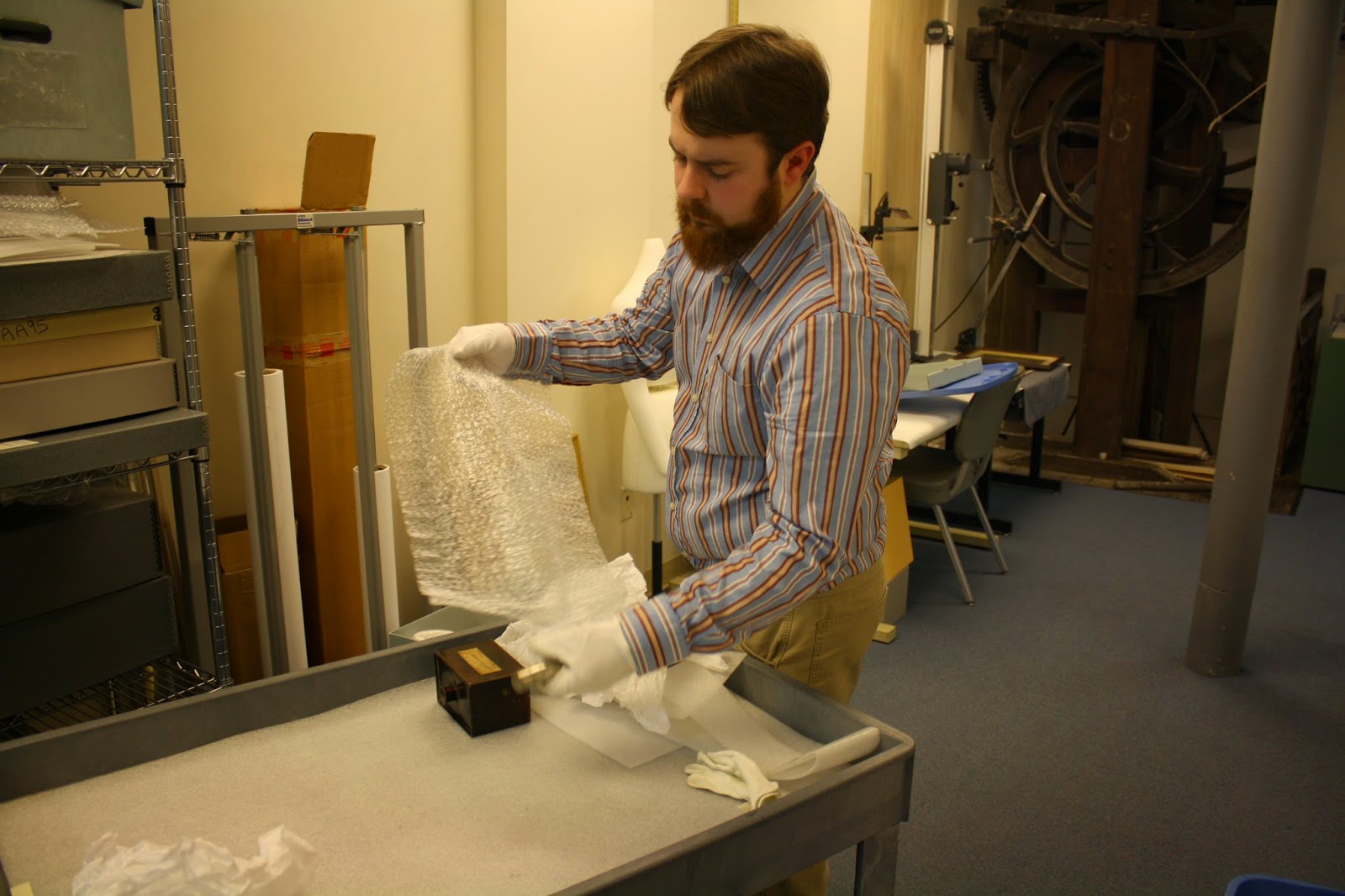
Kyle, helping to put away some of the returned artifacts.

When the exhibits have run their course the items are then returned and then they start the process of coming back to the museum’s collection.

 And they move down these hallways where we store all of our old exhibit panels.

Items cannot simply be placed right back into the collections room. The first step is to place them into quarantine.  The reason for this is to ensure that items have not been exposed to materials that may cause damage to the artifacts in the collections room.  The most common concerns may include bugs and mold.  While the artifacts are in quarantine, they are checked for anything that could damage not only themselves but other artifacts.

The cart on the right has boxes filled with returned artifacts.

Once the artifact's time in quarantine is up, they can return to the collections room, into the storage drawers where they are housed.  This procedure was followed last week with items that were out on loan, and with the items that came back from our location at the Pry House Field Hospital Museum, which closes down for the winter months.  This procedure is not limited to those items that leave the building, but also with artifacts that come out of the collections within the exhibits here at the National Museum of Civil War Medicine.

The Fitzpatrick items were some of the artifacts on display at the Pry House.

What is great about this process is not the paperwork, but that you can see in one room how awesome the collection is in its entirety.  There is everything from splints to books, from amputation kits to a Civil War Condom.  It is very fascinating to see these artifacts that are well cared for by the staff at The National Museum of Civil War Medicine.

The sword returned from the Fitzpatrick exhibit.

Thomas Frezza
 Photos courtesy of the National Museum of Civil War Medicine, except where otherwise noted.

Thursday, October 23, 2014

Antietam Time

The National Museum of Civil War Medicine recently received a donation of a collection of items which came from the Pry family.  If you are familiar with my museum, you will know that our first satellite location is the Pry House Field Hospital Museum out on the Antietam Battlefield.  If you are unfamiliar with the story of this fascinating property, take a look at our website here.  The Pry House was owned by Philip Pry’s family.  However, the items we just received belonged to the Samuel Pry family.  
An undated photo of Philip and Samuel Pry, courtesy of Betsy Web.


     Philip and Samuel Pry were brothers who both lived in Keedysville at the time of the Civil War.  They built the Pry House together in 1844, and a few years later they bought a nearby grist mill together.  They even married sisters!  Philip Pry married Elizabeth Cost, while Samuel Pry married Mary Cost.  In 1862, when the Battle of Antietam was fought, Philip & Elizabeth owned what is now known as the Pry House, while Samuel and Mary owned the Pry Mill.  Both of their properties were taken over and used as Union hospitals after the battle.  So you can see that the two families were closely connected!
A Library of Congress image of the Pry Mill.
     The most striking item from the collection is the clock which belonged to Samuel & Mary Pry.  It was described to me as a mantel clock, so I was quite surprised when a very large box was delivered to my office. 
You can see that the clock stands about 36” tall!  It is actually more of a shelf clock than a mantel clock.


     This is an eight-day weight clock and was manufactured by John Birge and Company in Bristol, Connecticut around 1834.  It has a large triple decker case with a carved eagle on top, columns on the sides, and round feet on the base. 
The top tier contains the clock face.  The small mirrored opening in the center can actually be raised to view the works inside.  If you look carefully on the column to the left, you can see it is covered by a piece of clear packaging tape.  I was not pleased to find that the shipper put that there!  While it came off of the varnished door frame cleanly, it was more problematic on the painted column.  A very gentle test at one edge proved that the tape was pulling the paint off the wood.  After a bit of research into the issue, I used a hair dryer to heat the tape, which allowed me to ease the tape off of the paint more cleanly.

The bottom tier has a hand-painted scene on the door, with a heart-shaped window in the center to view the pendulum.  The buildings portrayed in this scene appear to possibly be the original U.S. Capitol Building and White House.

     The clock had to be partly disassembled before it was shipped, plus the pendulum arm fell off in transit, so I found an experienced “clock guy” to put it back in working order.  Not only was he was able to give me a lot more information about the clock, he made a “house call” as well!
David Myers of Boonsboro, Maryland, oils the works of the clock.  It should be ready to run once he puts it back together!
Here’s a closer view of the brass clock works.  You can see the chime and the striker at bottom center.  The thin rod in the middle is the pendulum arm, and the cords on either side connect to two large weights.  The clock has one for the time and one for the chime.  Once a week, as the clock is wound, they are raised to the top of the clock next to the clock face. 

     Once I obtain a suitable case, I will have the Pry clock out on display at the Pry House.  I’d like to thank Betsy Web and Robin Jackson, descendants of Samuel & Mary Pry, for their very generous donation!  For now, you can hear the Pry clock chime in this video clip: 
Photos courtesy of the National Museum of Civil War Medicine, except where otherwise noted.


Originally published by Lori Eggleston
Guardian of the Artifacts

Thursday, October 2, 2014

Some Civil War Medicines

     It’s time for another new exhibit!  Last week I helped to install an exhibit out at the Pry House Field Hospital Museum, on Medicines in the Civil War.  NMCWM Educator, Kyle Wichtendahl, developed this exhibit, so my role was mainly to help choose the appropriate artifacts, and then to pack them and transport them to the Pry House.   
Don’t laugh, but I’ve found this to be an effective method of transporting smaller artifacts!  Of course the artifacts are padded and packed well inside this acid-free box first.  I like to tie the lid down to keep everything securely inside the box.  The seatbelt ensures that the box doesn’t slide around inside the vehicle.  The box with the larger artifacts is secured in the trunk with a cargo net.
     So, now that the artifacts are ready to go, let’s take a look at some of the drugs which were used during the Civil War.
One of the panels from the exhibit tells about some of the beneficial drugs of the time, such as opium and quinine, as well as some of the harmful drugs such as mercury and lead acetate.  Examples of each of these are on display in this exhibit.
Also on display is my museum’s TV star – the bottle of silver nitrate which was featured on Mysteries at the Museum!  You can see the post about that episode here.  The large syringe on display behind the bottle would have been used to inject this medicine.
This hospital knapsack could be easily carried, and allowed the battlefield medical personnel access to the medical supplies needed to treat the wounded soldiers.  The case exterior is made of black oil cloth, and it covers a wooden frame.  The interior consists of an upper drawer which swings out and down from the knapsack.  The lower portion of interior has wooden dividers for the medical containers and supplies.


This medicine tin is one of several which came from the knapsack.  It contained “Spiritus Frumenti” or medicinal whiskey.  As you can see from its label, this tin was made by T. Morris Perot & Co. of Philadelphia, specifically for the U.S. Medical Department.


Not all of the artifacts we wanted could be displayed.  I made the decision not to risk transporting this bottle of ether, even though it would have fit well into this exhibit.  Though it’s hard to tell in this photo, the bottle is still about a third full of liquid.  I did not want that glass stopper working loose during the ride in the car!

Our newest intern, Jennifer, was happy to assist with putting the artifacts on display!


Here, Kyle makes sure all the labels are placed correctly before we put the covers on the display cases.

And here’s the new exhibit!
     “Medicines in the Civil War” will be on display at the Pry House through 2015.  Come by and see it if you get the chance!
 
Photos courtesy of the National Museum of Civil War Medicine.

Originally published by Lori Eggleston
Guardian of the Artifacts

Thursday, August 7, 2014

Doctor Who?

     If there’s a little known hero of the Civil War, it has to be Dr. Jonathan Letterman.  I was reminded of that recently when the founder of the National Museum of Civil War Medicine, Dr. Gordon Dammann, gave a lecture on Dr. Letterman and his Letterman Plan.  Maybe you’ve never heard Dr. Letterman’s name before, but your life has probably been affected by his work.  The Letterman Plan, which is a system for treating and evacuating casualties from battlefields, is the basis for many aspects of our modern military medicine, emergency medicine, and even disaster relief.
Here is Dr. Dammann, talking about Dr. Letterman and his plan.  I think this is one of his favorite topics!

     At the start of the Civil War, there was no set procedure for removing wounded soldiers from the battlefields.  In some cases, the wounded were left on the battlefield for over a week, which meant that many of the men, who might have been saved, died from their wounds or from exposure.  While the army did have ambulances which could transport the wounded soldiers, the ambulances were under the control of the Quartermaster Department which procured and distributed most of the supplies for the army.  As you might imagine, the ambulances were not always the top priority in this system!  In fact, there were instances in which ambulances were appropriated to carry other supplies, or even personal items. 
     In 1862, just a few months prior to the Battle of Antietam, Major Jonathan Letterman was named the Medical Director of the Union Army of the Potomac.  His first step toward revamping the medical system was to establish a separate Ambulance Corps. He gave control of the army ambulances to the officers of the ambulance corps, he distributed ambulances to each regiment, he had enlisted men trained to serve as ambulance drivers and stretcher bearers, and he had the use of ambulance wagons for any non-medical uses forbidden.  
This Wheeling ambulance is one of the types of ambulance wagons used during the Civil War.  Illustration from “The Medical and Surgical History of the War of the Rebellion. (1861-65) Part III, Volume II.”
  
     Letterman also reorganized the system of medical treatment and field evacuation.  He applied a triage system in which the wounded were treated based on the severity of their wounds instead of the order they arrived.  He also established aid stations on the battlefields, where medical officers could stabilize the wounded soldiers and arrange for their transportation to a field hospital.  The field hospitals were located near the battlefields.  It was here that the soldiers received additional treatment, including emergency surgery if needed.  If more long-term treatment was required, the wounded were transported to the larger, more permanent hospitals which were usually located in the cities.
     The Battle of Antietam, the bloodiest single day in American history, was the first real test of Major Letterman’s new system.  It was a success.  Even when faced with over 23,000 casualties, his plan ensured that all of the wounded were removed from the battlefield within 48 hours, which undoubtedly saved many lives.  He continued to make changes and improvements, and in 1864 his plan was made official by an Act of Congress.
Though the equipment has changed, the Letterman Plan is still in use today.


     I’ll leave you with a quote from the NMCWM’s own website: Major General Paul Hawley, Chief Surgeon of the European Theater in the Second World War, said of Letterman, “I often wondered whether, had I been confronted with the primitive system which Letterman fell heir to at the beginning of the Civil War, I could have developed as good an organization as he did. I doubt it. There was not a day during World War II that I did not thank God for Jonathan Letterman.”
An 1862 photo of Major Letterman (first seated figure) and his staff in Warrenton, Virginia.  Library of Congress image.


Originally published by Lori Eggleston
Guardian of the Artifacts

Thursday, June 26, 2014

A Beautiful Day at the Pry House!

     I recently had some tasks to complete out at the Pry House Field Hospital Museum.  The Pry farm is gorgeous this time of year, and I will freely admit that I chose my Pry work day after consulting the weather forecast!  I was able to enjoy a beautiful sunny day there, while still doing my work.
My first task was to prepare to paint two display cases in the house.  This bright yellow color was a bit too distracting!  A more neutral color will allow our visitors to notice the artifacts on display and not the cases.
     I worked in a room which was closed off from the display areas in the house, so that I didn’t have to worry about the dust or paint fumes affecting the artifacts or the visitors!  I was also careful to protect the floor from any paint drips by laying down some sheets of plastic.  After a quick sanding and dusting of the cases, I was able to get the first coat of paint on both cases that morning.
     While I waited for the paint to dry, I worked on a few other issues in the displays.  I hid some pest strips in strategic areas, to cut down on the number of insects in the house.  Though we take as many precautions as possible to prevent insects from entering the house, historic buildings tend to have little cracks and gaps which still allow entry to some pests. 
     You may recall a post I did back in January about the Letterman desk which is on display at the Pry House.  (You can read that one here.) There was an issue with the amount of light to which it was being exposed.  Though curtains were installed in the windows to block much of the sunlight, I mentioned that I wanted to put a blue wool standard card on the desk to monitor the issue.  Shortly after that post, the entire desk was covered since the house was closed to the public for the winter.  I didn’t need to worry about monitoring its light exposure at that point!
This blue wool standard is used to help assess the amount of ultraviolet light damage to artifacts.  Half of it is covered to keep the light from affecting that side.  When I check it later, I will easily be able to see if the uncovered side has faded due to UV exposure.  You can also see that I placed the blue wool card out of view behind the label on the desk!
At lunch time it was a treat to be able to eat outside on the balcony, and to enjoy the view of the garden, barn, and mountains.

I wasn’t the only one taking advantage of the nice weather.  Kyle and Cooper were working hard to keep the Pry medicinal herb garden in good shape.

There are still more great views!  If you come to visit the Pry House Field Hospital Museum, don’t forget that there is an overlook out behind the house.  It allows for a spectacular view of the Antietam Battlefield!

     All too quickly, lunch time was over and I had to get back to my painting.
First though, I had to stop and pet Hazel, who’d come in to keep Katlyn company at the front desk.  How can you walk past that face without saying ‘hello’ to her?!
Back to work now!  The cases are already looking much better, but they need a second coat of paint. 

Two coats of paint did the trick.  You can see that one of the Plexiglas display tops is out of the way in the corner.  You can also see that there’s an easel set up next to it.  Though it may appear that the easel is out of place here, I purposely put it there so that no one would accidentally trip over the top.  Being clear and low to the ground can make them difficult to see when one is walking around and looking at other things…. not that I’m admitting that’s ever happened to me!

Finally, there was the little matter of cleaning up the mess!  It was certainly worth the effort to repaint those cases though.  Now the paint can “cure” for a few weeks while we work on the display of Civil War medicines which will go into these cases. 


Photos courtesy of the National Museum of Civil War Medicine.

Originally published by Lori Eggleston
Guardian of the Artifacts

Thursday, June 5, 2014

Another Day at the Pry House

     The last time I wrote about the Pry House Field Hospital Museum it was to document the renovations which were being done to the house and barn.  Take a look at what was done here.  
     Though the artifacts are normally put back on display in the Pry House in April, I couldn’t put them in the house during the renovations.  Having the roof replaced meant that the temperature and relative humidity inside the house would fluctuate much more than usual.  If you’ve read much of my blog, you’ll know that I aim to keep artifacts in an environment with stable temperature and relative humidity!  There was also a higher risk of leaks and of pests gaining entry to the house, as well as an increase in dirt and dust in the house.  It was just not worth the risk to the artifacts.
Now the Pry House has a brand new roof!

     Once the roof was finished and the house was cleaned, I was finally able to take the artifacts for the displays back out to the Pry House.
No one likes seeing empty display cases!
     Since there had been some extra dirt and dust produced during renovations, I also decided to wash the cloth covers in the cases before the artifacts were put back inside them.  
This foam block was designed to safely support and display an open book.  There is a sheet of foam in the base of the case as well.  The foam helps to cushion and support the artifacts on display.

Unbleached muslin is used to cover both pieces of foam, since this kind of fabric does not contain any dyes or chemicals which can damage artifacts.


Since the Pry House was used as the headquarters for Dr. Jonathan Letterman during the Battle of Antietam, his book, "Medical Recollections of the Army of the Potomac" is displayed here, on the foam support pictured in the previous photo.  After the Civil War, Dr. Letterman wrote of his tenure as the Medical Director of the Army of the Potomac and of the role played by the Medical Department under his direction.

The rest of the artifacts are back in the display cases as well.  Some of the artifacts on display include amputation instruments, an ambulance water keg, a home pharmacy kit, Irish Brigade items recovered from the battlefield, Dr. Letterman’s desk, and many other relevant items.  If you’re in the area, come and take a look at them!


Photos courtesy of the National Museum of Civil War Medicine.

Thursday, March 6, 2014

House work at the Pry

     Every homeowner knows that there’s always maintenance work which needs to be done to keep their building in good shape.  Historic houses are no different!  If anything, they can require more maintenance due to their age and the amount of visitor traffic they experience.  So, the Pry house and barn are undergoing some repairs and restoration work this winter courtesy of their owner, the National Park Service. 
Winter is a good time for these repairs, while the house is closed to visitors.   The Pry farm is certainly pretty when covered in snow though!
Work was done on the house windows in 2012.

These wooden shingles on the roof of the house were installed in the 1980s.  It’s time for them to be replaced!  This will help to protect the house from leaks and excess moisture.  It will also create a better environment for the artifacts which are displayed inside.  Don’t worry; there are no artifacts in the house right now!
So, for now the house is covered with scaffolding.
 

     There is work being done on the barn as well.  The middle section and west hay mow were repaired a couple of years ago.  Now the east hay mow and the corn crib on the east end of the barn are being repaired and restored.
Here is a view from the restored main section of the barn, looking into the restored west hay mow.
The corn crib is on the far right side of the building in this photo.  The east hay mow is on the right side of the main barn building.

The east mow will have new flooring installed, and its timbers repaired.
The corn crib will have new concrete footings and stone piers, and the joists and sills will be repaired.


Some of our visitors are already eager to get a look at the repairs!

     If you are in the area, I hope you can come for a visit as well!
Photos courtesy of the National Museum of Civil War Medicine.